
Elkins City Directory Shelf Years
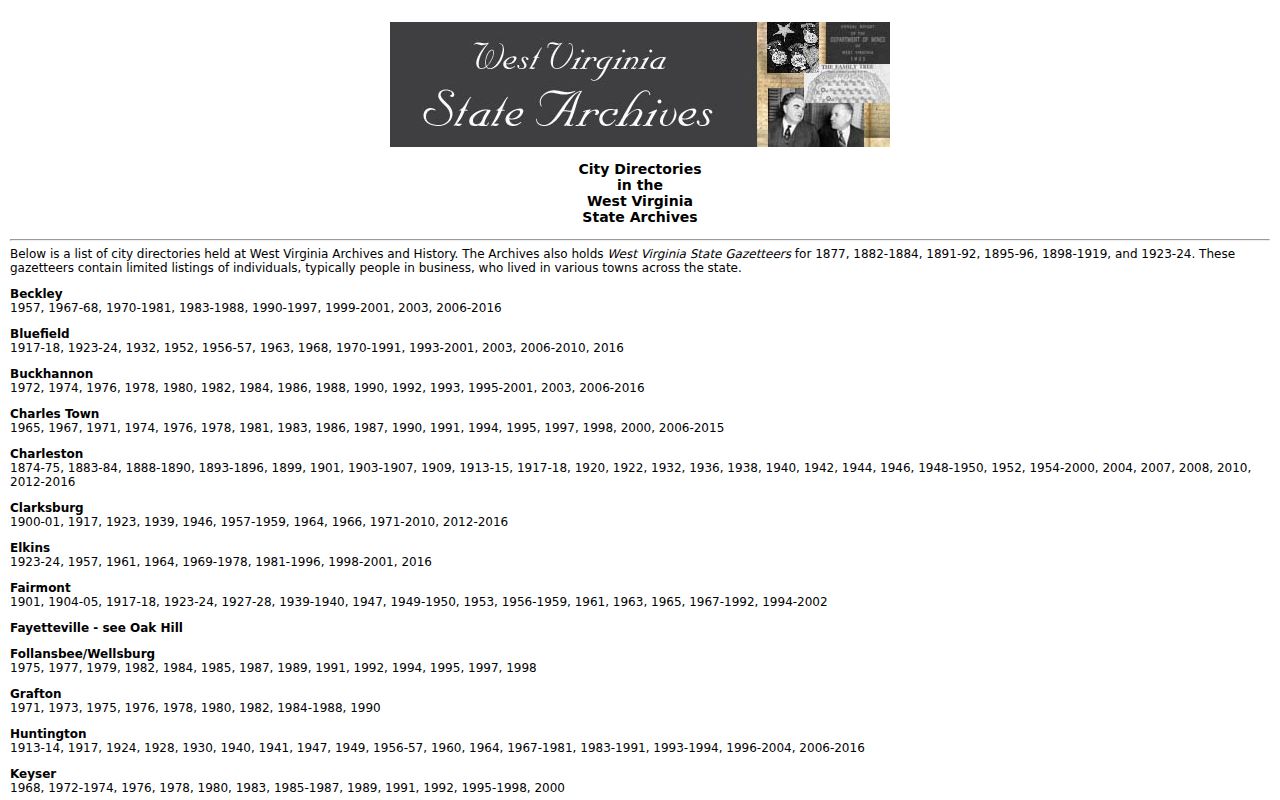
The strongest collection list comes from the West Virginia State Archives. Its Elkins city directories have clear years but no publisher or imprint on the public shelf page. NARA supplies a separate early run. The library, archive, or physical title page must settle the edition title and whether a volume has an address section.
| Collection | Years or extent | Where held | Access |
|---|---|---|---|
| Elkins city directories | 1923-24; 1957; 1961; 1964; 1969-78; 1981-96; 1998-2001; 2016 | WV State Archives | Archive inquiry or reading room; verify imprint |
| NARA Elkins/Randolph directories | 1921-24; 1926; 1929; 1933-34 | National Archives | Verify reel, item, and digitization status |
| West Virginia gazetteers | 1877; 1882-84; 1891-92; 1895-96; 1898-1919; 1923-24 | WV State Archives | Limited business and individual listings |
| Local history materials | Yearbooks, programs, maps, artifacts, newspapers, microfilm | Elkins-Randolph Public Library | Catalog and local-history room |
These holdings have gaps. They do not prove that no directory was printed in an unlisted year, and they do not support labeling every Elkins volume with a familiar national publisher. Cite the title page after staff confirms the physical item.
The archive page is the source for the exact state shelf run. Review the current holdings list before planning a visit.
The listed years are observation points, not a continuous annual record of every Elkins resident.
Elkins Directory Timeline and Gaps
The chronology starts before the first located Elkins directory. It moves through county, town, map, print, and census sources, each created for a different purpose.
- 1877-1919: listed West Virginia gazetteer runs offer selective town, professional, and business names, not a full resident count.
- 1889-1901: the railroad reached Elkins, the town incorporated, the county seat moved from Beverly, and South Elkins merged into the city.
- 1921-1934: NARA's Elkins/Randolph directory years bridge the early federal census era.
- 1923-2016: the State Archives list supplies scattered early issues, stronger late-century runs, and a last listed Elkins year of 2016.
- Current research: archive, library, and microfilm access still matters because no complete digitized Elkins run was verified.
The State Archives has a near-continuous sequence from 1981 through 2001 except 1997, but earlier decades are much less regular. Record a negative search as “not found in the consulted edition,” never “not in Elkins.”
NARA Bridges Elkins Directory Gaps
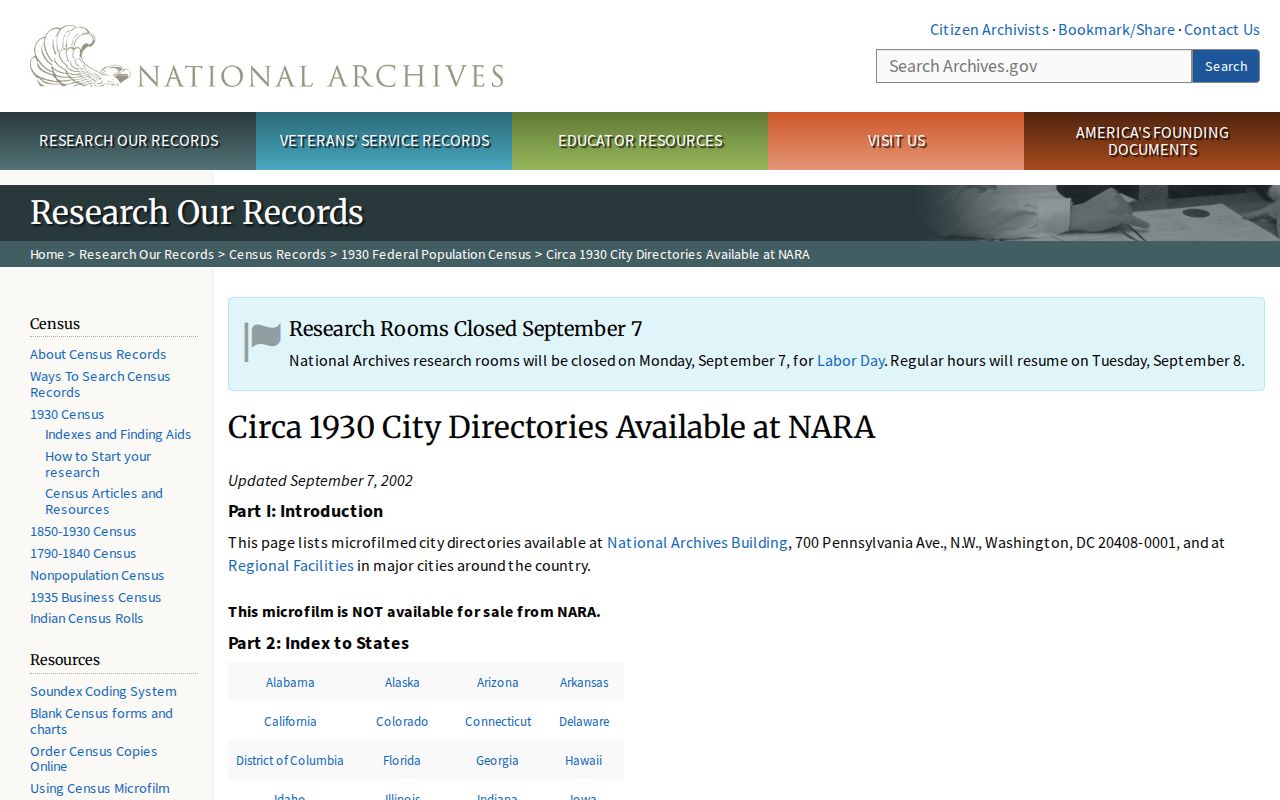
The National Archives 1930 directory holdings list Elkins/Randolph volumes for 1921 through 1924, 1926, 1929, and 1933 through 1934. Treat this as a separate federal collection rather than assuming it duplicates the state archive copies.
Those dates make a useful sequence around the 1930 census. A 1929 directory can place a person shortly before enumeration, while a 1933-34 entry can show an address or name after it. Verify each item's reel or call information and access status with NARA. The holdings page does not make every volume an online scan.
NARA documents the bridge years and archive context. Check the federal holdings entry before citing an item.
A federal holding can fill a year gap without changing where the original Elkins record was created.
Read an Elkins City Directory Entry
The public Elkins shelf list does not expose scanned entries. The field inventory below follows the Library of Congress directory guide and must be checked against the key in each Elkins edition. Arrangement and symbols can change between publishers and years.
| Name | Surname, given name or initials, sometimes spouse or household notation. |
|---|---|
| Work or business | A profession, trade, or business affiliation when the edition supplies it. |
| Address | House number and street, sometimes with a business address or telephone number. |
| Status notation | Widow or widower, boarder, or another abbreviated relationship may appear. |
| Owner or renter mark | Edition-specific; never infer its meaning without that volume's key. |
| Edition date | The printed year, which may differ from the date the information was gathered. |
Cite the volume title, publisher and imprint when visible, year, page, exact entry, and holding institution. A city directory entry may describe a person who moved after compilation or a business at the same address. It is not an official census.
Elkins Directory Search Vocabulary
Three terms help readers move through a volume without forcing a modern meaning onto old print.
- Criss-cross directory
- An address or telephone arrangement that lets a reader start with a place instead of a surname; not every Elkins edition is verified to contain one.
- Householder index
- A name or address finding aid for the listed head or principal person, with scope set by that edition.
- Abbreviation key
- The front matter that defines street, status, and other shortened terms used by that publisher.
- Gazetteer
- A geographic or business reference that may name merchants and professionals but does not list all households.
Photograph or transcribe the title page and abbreviation key before copying entries. That small step prevents a guessed symbol from turning into a false family fact.
Elkins Library's Analog Directory Desk
The Elkins-Randolph Public Library is the best local first stop. A report on its Local History and Genealogy Room describes Davis & Elkins College and Elkins High School yearbooks, Forest Festival programs, maps, artifacts, genealogy guides, local documents, Civil War history, microfilm, and Elkins Enterprise newspapers. A work table, outlets, and a Chromebook support longer searches.
Ask separately for local history, city directories, microfilm, yearbooks, obituaries, cemetery records, and house history. No public source confirms a complete reverse-directory shelf, full obituary index, funeral-home register, or paid genealogy database. A precise year, street, school, event, or newspaper title gives staff a much better starting point than a broad name request.
The library's public site shows its current services and contact route. Confirm present access before traveling because research space and services can change.

The library can connect printed Elkins city directories with sources that never became part of an online name index.
Elkins Newspapers Fill Directory Years
The WV State Archives Randolph newspaper list supplies the names-and-events layer between editions. The Inter-Mountain has scattered early issues, a long January 1915 through May 2015 run, later 2015 and 2016 segments, and material continuing to the present in the researched inventory. Randolph Enterprise appears in several runs from 1878 through 1984. Elkins Mail, Randolph Review, Tygart Valley Press, and Tygarts Valley News add shorter spans.
Search an obituary, wedding notice, legal notice, social item, election result, or advertisement near the directory year. A street plus an event can separate two people with the same initials. Newspaper title variants include The Inter-Mountain, Elkins Inter-Mountain, and Daily Inter-Mountain, so use each form in catalogs. Issue gaps still matter.
A newspaper statement is a lead, not title proof. Pair it with a deed, court file, census, cemetery record, or a second family source.
Beverly Comes Before Elkins Directories
For pre-1900 family work, start with Beverly and countywide Randolph sources. Randolph County was created in 1786, Beverly served as its early county seat, and Elkins became the seat in 1900 after a three-year dispute. Elkins itself was incorporated in 1890. Older court, church, newspaper, and family references may therefore use Beverly or a county district instead of the later city name.
The Beverly Heritage Center maintains a public, non-lending research library with local and Civil War history, original documents, manuscripts, and oral histories. The Randolph County Historical Society holds artifacts and records from county firms and people, while ARFHS focuses on genealogy and cemetery publications.
Map Elkins Between Directory Editions
WVU Archives lists Elkins Sanborn fire-insurance maps for 1899, 1902, 1905, 1910, and 1923. They can show street names, house or block numbers, footprints, construction material, number of stories, use, walks, and property lines. A building absent in one sheet and present in the next creates a construction window, but it does not identify the occupant or establish title.
The March 17, 1897 downtown fire is a useful date pivot. Much of the original business district was destroyed, and Davis Avenue was rebuilt in brick and stone. Compare pre-fire newspaper and deed references with the first later Sanborn sheets. The event did not establish a courthouse-record loss, so it should never be described that way.
Use a map beside a city directory page, not instead of it. The printed address supplies a person or business at an edition date; the map supplies physical context near another date.
Trace Families Through Elkins Directories
A careful Elkins city directory trail follows both the person and the address. Initials, spouse notation, occupation, and street number help distinguish names. A change in one field should be checked, not smoothed over.
- Begin with a known name or address and copy the entry exactly, including abbreviations and page.
- Search the alphabetical and address sections separately, testing initials, married or widow notation, shortened street names, and earlier numbers.
- Move to the next available edition, not an assumed annual issue. Record moves, new names at the address, and gaps.
- Pair the directory with the public census nearest that decade. The 1950 census is the latest generally public decennial release under the 72-year rule as of the research date.
- Bridge missing years with newspapers, yearbooks, deeds, maps, obituaries, and cemetery publications.
- Confirm identity through a second feature such as spouse, middle initial, occupation, address, deed party, or obituary relationship.
A disappearance can mean a move, death, omission, changed name, unlisted status, or a missing edition. Census household composition applies to the enumeration date, while a directory reflects its own compilation cycle. Keep those dates separate.